
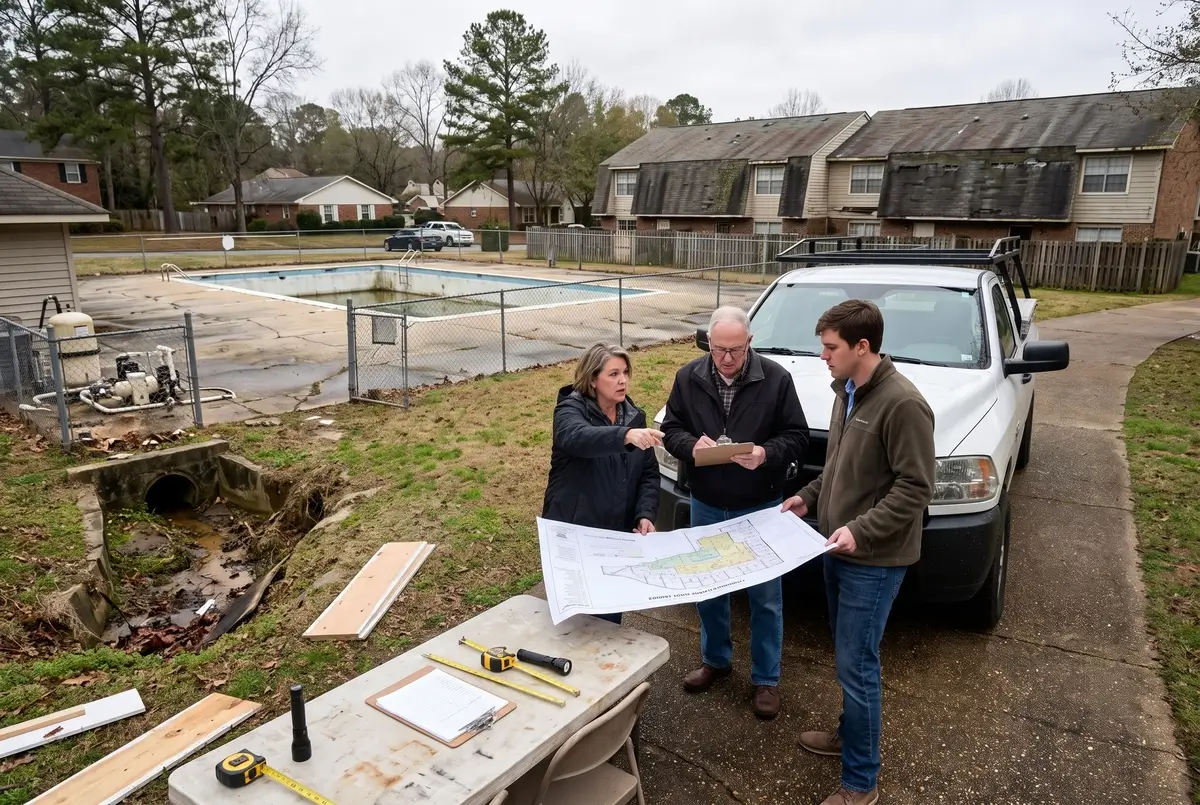
Pool deck repairs rarely announce themselves months in advance, and neither does a failing storm drain beneath a Hoover subdivision’s main road. A board might sail through three quiet budget cycles, then face two major failures in the same year. That whiplash connects to a broader pattern explored in our piece on self-managed boards facing decision fatigue, where unrelated problems stack up until a board runs out of room to respond calmly. Reserve funds built on outdated assumptions tend to produce exactly this kind of pileup.
Here’s a look at what’s pushing special assessment costs upward in Hoover communities and the groundwork that keeps a board from getting caught flat-footed.
Key Takeaways
- Reserve studies built on older assumptions rarely track how fast Hoover’s shared infrastructure actually ages.
- Rising contractor demand across the Birmingham metro makes repair timelines less predictable than before.
- A repair left unaddressed for multiple budget cycles tends to resurface as a far costlier emergency.
- Owners respond better to assessments when boards share financial detail consistently, not only when a crisis hits.
- How a board has handled past rule enforcement often colors how residents react to a new financial request.
Why Older Reserve Studies Undercount Hoover’s Repair Costs
A reserve study reflects the assumptions in place the year it was written, and those assumptions age quickly once labor costs, material prices, and local contractor availability shift. A pool resurfacing project budgeted at a certain figure three years ago can cost considerably more today, and a board relying on that older number walks into the vote underprepared.
A handful of factors drive this gap in Hoover specifically:
- Licensed contractors for pool, roofing, and drainage work stay in high demand across the greater Birmingham area, which stretches both timelines and rates.
- Material costs for roofing, concrete, and piping climb every budget cycle, independent of any single project.
- Insurance premiums covering shared amenities renew higher most years, shaped by regional claims history.
- Dues approved several years back stay flat while the underlying repair costs keep moving upward.
Owners frequently want to know why dues keep rising without a visible project underway, and the straightforward answer traces back to this gap between the study and the current market.
A Hoover Community’s Experience With a Delayed Repair
A mid-size Hoover association offers a clear picture of what happens once a known issue sits unaddressed for too long.
Warning Signs Over Two Budget Cycles
The community’s reserve study flagged a cracking retention pond wall two years in a row. The board held off both times, worried that homeowners already adjusting to rising property taxes wouldn’t welcome another increase on top of it. The board treasurer at the time later said she didn’t feel ready to reopen that conversation so soon after the previous budget meeting had gone poorly.
What Followed the Delay
A heavy rain event pushed water past the weakened wall, flooding several yards and damaging a stretch of common-area fencing. The emergency repair ran well past what a planned reinforcement project would have cost a year earlier, and the board had no choice left but a special assessment due within thirty days. The median special assessment reached $1,100 per door in 2025, and in communities dealing with drainage or structural failures, that number often climbs higher once emergency contractor pricing gets factored in.
Financial Reporting Habits That Build Owner Confidence
Boards earn trust through consistent, detailed reporting rather than a single explanation offered after a problem has already escalated. Our article on financial data not simplifying board decisions gets at a point worth repeating here. Accurate numbers alone rarely settle disagreement on their own, and timing matters just as much as accuracy.
A few warning signs tend to surface before a funding gap becomes a surprise bill:
- Monthly financial statements arrive late or get skipped for a cycle.
- Reserve balances get discussed verbally at meetings but never appear in writing.
- Vendor invoices show up that weren’t part of any earlier budget conversation.
- Homeowners keep asking the same financial questions because the numbers were never clearly explained the first time.
Insurance pressure shows up in other regions too. Florida homeowners now pay an average of $2,691 a year for property coverage, a figure that’s climbed nearly 50 percent since 2020. Every region carries its own cost pressures, but reserve accounts absorb that strain in similar ways regardless of location.
How Past Rule Enforcement Colors a Board’s Next Financial Ask
Special assessments tend to meet the most resistance in communities where homeowners already feel excluded from decisions. Our discussion of HOA rules dividing Hoover residents touches on a dynamic that resurfaces during assessment season too.
That friction tends to follow a recognizable path. Homeowners question the math even when the figures hold up, meeting attendance spikes, and the conversation grows tense fast. Old disputes over fence colors or parking violations resurface during the vote, seemingly out of nowhere. A homeowner who already feels unheard rarely extends patience to a large bill, and he’ll typically say so at the next meeting, sometimes in front of the whole room.
Steps Hoover Boards Can Take Before the Next Vote
How a board prepares before a vote usually shapes the outcome more than the dollar figure itself. Our guide on maintenance plans requiring full board agreement lays out the groundwork that makes this step go more smoothly.
A short list of moves can reduce both the size of an assessment and the resistance that follows it:
- Pull the current reserve study and compare it line by line against actual account balances, rather than relying on memory or last year’s summary.
- Request updated contractor bids instead of carrying forward pricing from a few years back.
- Review delinquency rates closely, since unpaid dues often widen a shortfall further than the board expects.
- Share the full reasoning with homeowners well before the vote takes place, not after the notice gets mailed out.
- Schedule routine maintenance inspection visits so small issues with pools, roofs, and drainage get caught while they’re still inexpensive to fix.
Boards can also draw on resources built specifically for association board leadership to weigh their options before a vote locks anything into place.
FAQs about HOA Special Assessments in Hoover, AL
How often should a Hoover HOA revisit its reserve study?
A full update every three to five years works for most associations, paired with a shorter annual review to catch cost shifts before they widen into a bigger funding gap.
Can a Hoover board split a special assessment into smaller payments?
Many governing documents allow installment arrangements, though specific terms differ, so boards should check their bylaws before offering homeowners a payment schedule.
Will a pending special assessment affect a home sale in Hoover?
It can, since buyers and lenders often ask about outstanding assessments during due diligence, and an unresolved one may slow down closing or affect financing approval.
What happens when contractor bids come in higher than the reserve study projected?
Get a second bid to compare pricing, then update the reserve study’s assumptions so future budgets reflect current market rates instead of outdated figures.
Do shared amenities like pools and retention ponds usually fall under a master insurance policy?
Coverage depends on the specific policy and governing documents, so boards should confirm what’s included before assuming a repair will be offset by insurance.
What Hoover Boards Gain From Watching the Numbers Closely
Most emergency assessments trace back to a number someone chose not to look at closely enough, a year or two before the failure showed up. PMI Birmingham Region has sat across the table from enough Hoover boards to know the difference between a community that stays ahead of its reserve math and one that gets blindsided by it usually comes down to how often someone actually opens the file.
Pools, roofs, and drainage systems won’t wait for a more convenient budget year. Set up a reserve fund check-in with our accounting team so your board has real numbers in hand well before the next repair turns urgent.